Monday, February 27, 2012

(5) Interactivity #3 - Technology Inventory for English Education I

As a future educator, the relevance of this exercise is multifaceted because it provides both the teacher and student with various methods to help aid in learning, organization, collective contribution and collaboration with peers, while further reinforcing education when needed.  Most of these aids are effective for teachers because they provide them with chances to visualize and see Webinars to continually reinvent their craft of teaching.  It also helps teachers in trying to aid students by providing assignments and classroom exercises from outside the classroom to give them feedback on their work.  For students, these technologies provide them with interactive ways of learning, organization skills to aid in understanding, and unique ways to express individuality. 
The group inventory interactivity proved to be a truly enriching aspect to incorporating technology in a classroom.  By working collaboratively as a group, I have been exposed to far more unique technologies than had I done this exercise alone.  These technologies also present to me that, as an educator technology will be a driving force in content comprehension for students.  It will push students further toward an interactive learning.  I also found myself making notes on several of these technologies because I could see how prevalent their usage or involvement would aid in a lesson or help students better understand a concept.  The Google Docs Spreadsheet also allowed for a shared contribution to a greater whole of the project, something that I was not familiar with but will definitely use again in the future.  In all of the content posted, the most important aspect that was threaded through most of our technologies is infusing the Expressive Authoring and accountability aspect to English content.  This particularly means that the most important aspect to English content knowledge is infusing one’s own writing, ideas, and understanding with creativity.  Such technologies like Prezi (for creating presentations), Penzu (online diary writing and sharing), and Wordle (word clouds infused as art) are all interesting to use in classrooms because they provide students with interactive and unique way of expressing themselves.
By meeting with Lizz and Guiliana, we were able to discuss our approaches to using such technologies as well as supplying each other with additional brainstorming and thinking outside of the box for more useful technologies to be included within the spreadsheet. These technologies might be effective for trying to teach kids to work through their dependent reading behaviors like we have learned in READ 411.  It might also be beneficial to see how their content and understanding responds through an assessment as we are learning in CURR 314.  Though each technology does not replace a teacher teaching the content, most provide students with a great additional support to comprehension when not inside a classroom.  As teachers, we will need to supply our students with methods that can help them outside of the classroom so that learning can be a process anywhere they are regardless of a classroom styled instruction.


Friday, February 17, 2012

(4) Hope and Enthusiasm Are Soaring In These Classrooms, But Not Test Scores....


Hello Fellow Technology Junkies,

I stumbled upon this article and it brings up the ever-present debate of technology in the classroom.  It examines the quintessential discussion between teachers, parents, students, and how technology seems to wiggle its way into the classroom.  Does it have a place OVER other educational subjects like Music, Art, and Physical Education especially when integrated into curriculums from younger and younger grades? And most importantly, does it seem to be helping students more or hurting them by restricting their educational integrity?

With district budgets soaring into schools to help revolutionize student learning and performance, is it bad if it seems to be backfiring when examined by standardized tests results?

http://www.nytimes.com/2011/09/04/technology/technology-in-schools-faces-questions-on-value.html?pagewanted=1&_r=1&sq=in%20classrooms%20of%20future,%20stagnant%20scores&st=cse&scp=1

--What do you guys think? Sound off with comments!

Monday, February 13, 2012

(3) The 21st Century Learners


After researching some aspects of influential technologies in classrooms, I came across a YouTube video from both the MacArthur Foundation and the Pearson Foundation that clearly exposes the intent of technology for teachers and students alike.  The video examines aspects that many of us are familiar with, but it does help to enrich the facets of learning inside students' minds to teachers when examining the role that technology plays in our students lives inside school and outside their school lives as well. Students engage in technology not only for their own benefit, interest, and enrichment but participate in technology and its various outlets as methods for classification among the sea of sameness in our society.  They like to be challenged. They like to be defined by their abilities and also be explicit in their uniqueness when being compared to others. Theses students and their mastery of new abilities are the potential figureheads of future development in various avenues such as civic and social interactivity, political and social movements, creativity in its own rights, and the future of education as well.


Though we have learned many important qualities that make up the distinct primary and secondary discourses within our lives, this video engages students to connect those discourses in some loosely bound fashions in attempt to bridge the present gap and start doing so by using technology as a building block.  It inspires students to gain literacy of learning as well as standards and expectations that will allow them to better incorporate technology in their lives as a basis for future development and enrichment.  This is also where we as  teachers will provide the necessary insight and encouragement to help further students achievements and aspirations.  


Technology and its immense impact is somewhat of a vicious cycle that can be aimed toward either fruitful rewards for students as well as futile goals simultaneously.  Despite the video being posted onto YouTube in 2010, it still provides insight of technology in a classroom as it undergoes modifications as well as changes for better or worse.  The difficult aspects for us as educators will be defining the limit of technology and where it will be most efficiently used within a classroom setting.  It is our responsibility to distribute some content knowledge, but also our responsibility to know where formal learning takes place without technology or its counterparts.  


It is not just the aspect that these students have learned and are now learning objectives that will help them reshape the world that we live in, but they are also able to see the differences between the learning processes that occurred in the 20th century and learning that is now occurring in the 21st century. Various types of media are being revolutionized around every corner and continue to be reinvigorated in classrooms each day. The most important question posed within the video is the issues of how to link outside learning of technology as a community experience into the formal learning process inside the classroom. The learners of the 21st century are able to see and reflect on technology as a backbone to their creativity, as the incessant drive for their future endeavors, and as the definition of their experiences in learning.  It is critical and ever present that the role of educators aims to foster a productive and healthy experience with technology that will not only enrich learning but inspire our students as well.


--View the video below and see if you agree with how they feel education of technology is represented. Also examine the role teachers must play in response to the ever-growing cloud of technology as it storms in and out of the classrooms


Works Cited:
The 21st Century Learner Video:
http://www.youtube.com/watch?v=c0xa98cy-Rw&feature=related
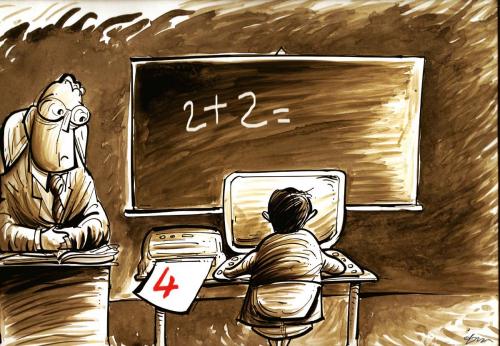
Header Image:
http://www.toonpool.com/user/550/files/technology_244495.jpg

(2) Interactivity #2 - Technological Influence on English Education


Television heavily captured the attention of children while in school in the mid 20th century by influencing their learning and allowing them to visualize the written word in a way that the radio never did.


-----------------------------
Images found via Google Images searches
TV film picture background: http://www.wa2ise.com/radios/tv.html

Radio picture: http://www.anythinggoes.fm/anythinggoes/?page_id=247