
Times are changing in every aspect of our lives. The picture above displays a person reading braille from a traditional 8x7 form in order to study materials and read concepts for a lesson. This type of instruction has dramatically changed over the past few years. While students might rely on notebooks and pens for note taking, the transition to laptops and tablets has changed the dynamics of instruction and concept understanding in classrooms everywhere. Problems arise when these advanced technologies cannot help disabled or special needs students. Tablets performance in classrooms is unconventional, but how might their performance help impact the learning of blind students who cannot type their notes or see the applications on their tablets?
In a Wisconsin school district, blind students are being reengaged into technological learning by the use of an iPad application called Refreshabraille as well as smart attachments like the Omnifier. When combined together, these advancements allow blind students like Kyle, age 7, to read stories that are on his iPad by use of the technology of braille dots popping up as the story progresses on an iPad case. The dots raise on the case as it "reads" the story and adapts it for a blind person. Though Kyle may not be able to see the story and read it on the screen, he can read it through the braille bubbles appearing on the Omnifier case that allow him to follow stories and learn new concepts. When he finishes the first sentence, the next sentence in bubbles appears so he can continue reading. Other iPad applications like VoiceOver help students like Correy who are dyslexic to read by reading aloud the content on the screen. Correy, who struggles while attempting to sort words and read them from a book, will see the words on the screen as they are highlighted and being read to him from the iPad. This application helps students to focus on "problem" words to help struggling readers keep reading with assistance.

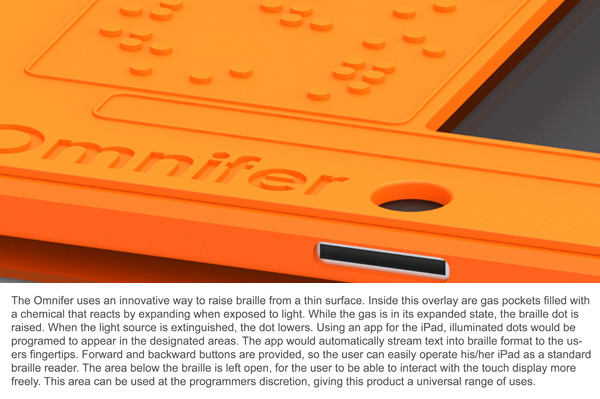

Though technology may be debated widely while being used in instruction, the applications and attachments here provide students with capabilities that can change their education immensely and advance their abilites to absorb new concepts. Though funding is required through Medical Assistance applications for these, blind students as well as diagnosed struggling readers will have various new learning styles that can revolutionize their understanding while still honing in their abilities of comprehension.
What do you think? Does "it", meaning advancing technology, have a place in a classroom for students that have disabilities that prevent them from some comprehension or learning? Sound off with your thoughts or comments:)

Girard, thanks for the summary about this unique accommodation for students.
ReplyDeleteI saw this article and was going to blog about it, but it was just so overwhelming that I didn't know what to say about it aside from a ramble about how as technology advances, it's great that it's advancing tenfold for students with disabilities. Looking at Best Buy commercials and keynote speeches for technology they're almost always "LOOK HOW GREAT THIS IS. IT'S BIGGER/SMALLER. IT'S FASTER. IT'S BRIGHTER. IT'S GOT SURROUND SOUND." But there's people in the world where none of those things matter. I think it's amazing that there are groups of engineers, software designers, and other thinkers who see these products come out and instantly formulate a way to design it to truly be great in unique ways. The only technology that's being developed, it seems, is touch screen. This is great for those who need the accommodation to be interactive, but there are people in the world who have no use for touch screens. It seems most companies are fading out devices with keypads or keyboards, which must seem like a daunting future for people in the blind community. Most people would see technology like the Omnifer and say "If you're blind, just don't get an iPad! This shouldn't be that big of an issue!" but it is that big of an issue, and no disability should prevent people from moving forward with technology! I can't wait to see how something like the Omnifer will revolutionize classroom learning for blindstudents, especially those that are tired of braille books the same way students are tired of black and white text books.
ReplyDeleteGirard,
ReplyDeleteI really enjoyed your article as well as your posting. I fully believe that technology should be used as an aid for students with disabilities. I was previously unaware of many of the tools available to students, such as the omnifer, and I feel that this would be an innovative way to engage students and make curriculum more accessible to all. I feel that these technologies could make learning more interesting and exciting for students. Thanks for sharing!